The site or page is new
Google may simply not have crawled or processed it yet. Google's own recrawl guidance says this can take from a few days to a few weeks.
 ✦ FREE Website Preview
If your website is live but you cannot find it on Google, work out whether the problem is discovery, indexing or ranking before making random changes.
The first question is not “why am I not number one?” It is “has Google discovered and indexed this exact URL?” Check that in Google Search Console before changing titles, rewriting every page or repeatedly requesting indexing.
Google may simply not have crawled or processed it yet. Google's own recrawl guidance says this can take from a few days to a few weeks.
An accidental noindex, robots rule, authentication wall or server problem can prevent normal indexing.
If nothing links to the page and it is missing from the sitemap, crawlers have fewer obvious routes to find it.
Canonical tags help search engines understand the preferred version of similar pages. A wrong canonical can send confusing signals.
Discovery does not force indexing. Search engines can choose not to index pages they consider duplicate, low-value or otherwise unnecessary.
This is a ranking problem, not an indexing problem. Relevance, competition, quality and authority matter after indexation.
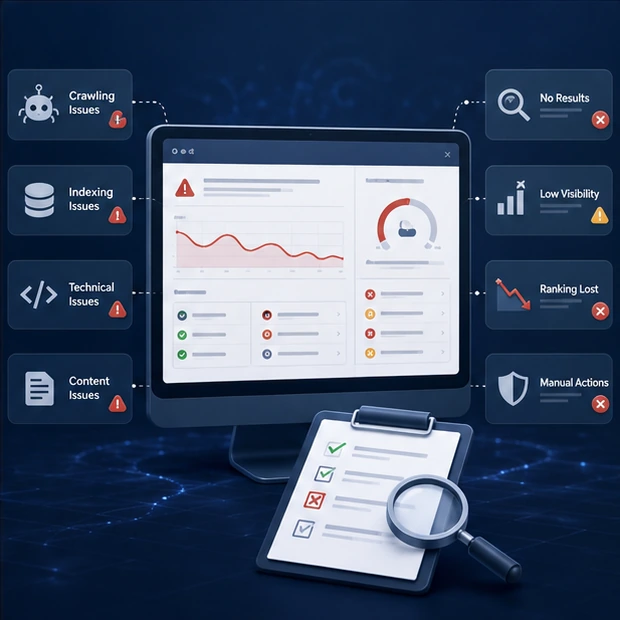
Google explicitly says a crawl request does not guarantee instant inclusion—or inclusion at all. The strongest long-term response is usually to fix genuine technical barriers, improve the usefulness of the page and strengthen the site's internal and external signals.
Separate indexing problems from ranking problems. If the URL is indexed, stop troubleshooting crawl access and start evaluating search intent, content quality, competition and authority.
On 17 August 2026, Vantora Web Studio completed its own search-visibility setup and recorded a useful technical snapshot: the XML sitemap had been submitted to Google Search Console and Bing Webmaster Tools, 31 sitemap URLs were submitted through IndexNow, Bing reported the homepage as successfully indexed with no SEO/GEO issues, and a Bing Site Scan crawled 37 pages with 0 errors and 0 warnings.
Those results confirm that the technical discovery and crawl foundations were working at that point. They do not guarantee a search position, traffic level or future ranking.
The useful lesson is not “Vantora will rank because the scan was clean.” The lesson is that technical blockers were checked and removed from the list of obvious problems, allowing future decisions to be based on real indexing and performance data.